Legacy of the Ancients
869 plays 1987 #RPG
Legacy of the Ancients is a fantasy role-playing game developed by Quest Software and published by Electronic Arts. It was originally released for the Commodore 64 and Apple II in 1987, followed by an MS-DOS conversion in 1989. Created by brothers Chuck and John Dougherty, the game uses an updated form of the engine developed for Questron, although it tells an independent story and does not require any knowledge of the earlier title.
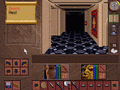
The player assumes the role of a young shepherd who discovers a dead adventurer and takes several objects from the body, including a mysterious leather scroll known as the Wizard’s Compendium. This act causes the Galactic Museum to appear and marks the shepherd as the latest person charged with destroying the dangerous artifact. The museum serves as the centre of the adventure, gradually revealing information, equipment and new objectives needed to complete the quest.
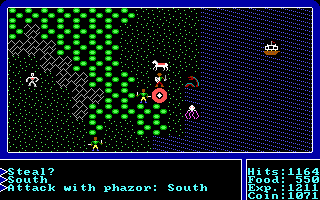
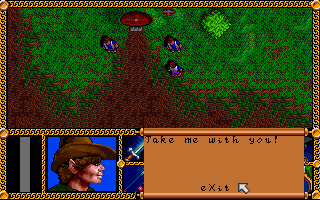
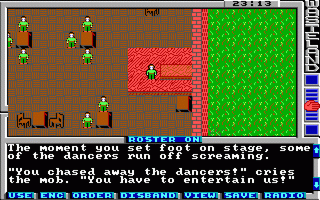
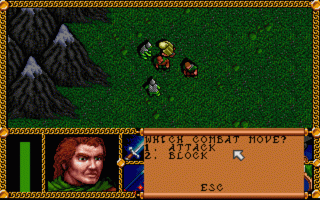
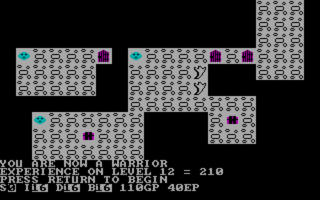
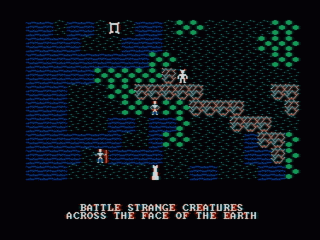
Exploration takes place from an overhead perspective in the wilderness, towns and castles, while dungeons and the museum are displayed from a first-person viewpoint. The player travels between settlements, fights monsters, purchases weapons and armour, searches for treasure and descends through multi-level dungeons. Towns also contain banks, shops, healers and casinos. Banks may be robbed, but doing so attracts guards who remember the offence whenever the player returns to that town.
Progress is closely connected to the museum’s exhibits. Display cases can be activated by inserting special coins obtained from defeated enemies, purchased during encounters or discovered at the lowest levels of dungeons. The exhibits provide useful items, information and access to further stages of the quest. Unlike many contemporary role-playing games, Legacy of the Ancients does not award conventional experience points; character levels are gained by completing specific objectives. Several museum attractions and town-based minigames can also permanently improve the hero’s attributes.
Contemporary reception was generally favourable, with particular praise directed at the colourful presentation and the museum as an unusual central location. Computer Gaming World regarded it as an advance over Questron and considered its difficulty appropriate for beginning and intermediate players, while Dragon awarded it three and a half stars out of five. Its frequent combat and relatively limited interaction can become repetitive, but the mixture of overhead exploration, first-person dungeons, gambling, minigames and exhibit-based progression gives the adventure a distinctive identity among role-playing games of the late 1980s.
Text: RetroGames.cz, licensed under CC BY-SA 3.0
Controls
This is a PC game: it uses the keyboard the way it did under MS-DOS, and the mouse where the game supports it. Click the game screen first so it gets your key presses.
Many DOS games start with a menu or ask a question first — read the screen and answer with the keyboard. Arrow keys, Enter, Space, Ctrl and Alt are the usual game keys.
Live chat
Connecting…
Controls
This is a PC game: it uses the keyboard the way it did under MS-DOS, and the mouse where the game supports it. Click the game screen first so it gets your key presses.
Many DOS games start with a menu or ask a question first — read the screen and answer with the keyboard. Arrow keys, Enter, Space, Ctrl and Alt are the usual game keys.
Comments